Stealing the Show a History of Art and Crime in Six Thefts Book Review
Inside view of art crime at the Met from the person tasked with preventing information technology
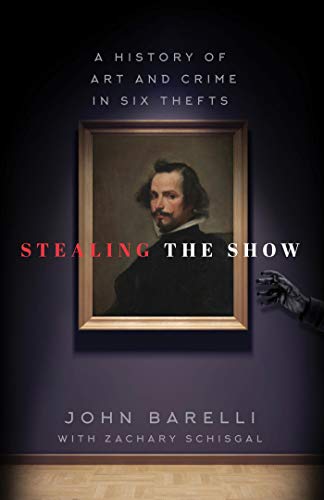
Stealing the Show: A History of Art and Crime in Six Thefts
past John Barelli with Zachary Schisgal
2019, Lyons Press
There is cypher I love more than than a expert art crime story. Don't get me wrong, I don't really desire art to be stolen, just if it is I want to hear near information technology, preferably from someone with enough insight and experience to both tell a good story and to make information technology meaningful. Someone who knows what they are talking nearly.
John Barelli certainly knows what he is talking virtually. With nearly 40 years in the security section at the Metropolitan Museum of Fine art (many of those as director), and with a PhD in Criminology from Fordham University focused on art theft (available here), Dr Barelli has experience and insight in abundance. The theft stories in "Stealing the Show" are good reads.
"Stealing the Show" is not an bookish volume, and I notation that considering I retrieve that is a major positive point in its favour. Dr Barelli has managed to write a fairly light and entertaining memoir nearly exactly what I am interested in, without weighing the stories downward with over assay. In other words, this is the kind of book I like to relax with at the end of the 24-hour interval. Information technology is a book that doesn't feel like "work" (although information technology is work, of grade). I gulped this book up in two sittings, reading with relish.
But that's not to say that the book lacks any sort of belittling connecting tissue. It is a memoir, yes, but through the stories, Dr Barelli puts forward the thesis that art thefts are almost always based on opportunity. You may be thinking "well that is obvious", only it really isn't. Dr Barelli doesn't support the idea that all fine art thefts are so-chosen "Crimes of Opportunity", although I retrieve he would probably argue that many of them are. Rather the media narrative of art theft as being the issue of all-encompassing pre-planning and grooming, or the idea that a motivated art thief will find a style to steal a target art piece no matter how hard the task is, but doesn't concord upwardly in his extensive experience.
The thefts from the met that Dr Barelli describes, none of which I had ever heard about before, by and large involve thieves who chance upon a situation that is exploitable and they exploit it. No repelling down from the museum skylight and creeping nether light amplification by stimulated emission of radiation beams to advisedly cut the example open with a drinking glass cutter. Nope, the opportunistic MET thieves do things similar notice spaces between case doors that they tin stick a wire in, or realise no one is really watching them if they request to look at baseball carte albums, or only rip statues off their bases when no 1 is around. Many art thefts are "inside jobs"; indeed Dr Barelli seems to e'er consider this possibility first when evaluating a theft. Thus, in Dr Barelli'southward opinion, that museum security is about reducing opportunities. While that might mean target hardening, equally well as getting creative in detecting exploitable situations.
As my co-authors on a few recent papers accept lamented, in that location is a strange lack of scholarship on the topic of museum security. It is a huge gap that, very seriously, needs filling. Even though information technology isn't styled equally an academic work, "Stealing the Show" is a valuable contribution to this expanse. Here'south a very experienced ex-caput of security at a world-grade museum talking about his experiences with crime? I am going to be citing this book in my research for sure.
At adventure of getting lost in a tangent, one pocket-sized thing in "Stealing the Bear witness" surprised me. In a section where he was discussing Banksy engaging in a contrary art theft at the Met, so he put an artwork of his ON the wall rather than steal i of the Met's pieces, Dr Barelli said that "the Met and other museums did not wait on this prank favorably". Now this is the exact opposite of what I ever thought was the case. I thought that for the minimal cost of maybe having to dab a little pigment on part of a wall, the museum not just got a totally gratuitous and very valuable Banksy work, but they too got the media publicity of reporting on the incident.[one] I suppose, though, that Dr Barelli is thinking about this from a security point of view and most people trying to illicitly hang artworks on the walls of the Met are not Banksy, but am I missing something here?
Banksy, if you are reading this which I suppose is non impossible, you are welcome to hang a piece on my wall. I'g absurd with that.
Coming back to it, if yous are like me and yous just want to sit down down in the evening with some new-to-you art theft cases recounted past someone on the inside of investigating them, "Stealing the Show" is the book for you.
[1] To exist fair, upon reviewing the press effectually these acts, the real shocker is that the press conspicuously feels they have to innovate the reader to Banksy. While information technology is hard to remember a fourth dimension before Banksy was all up in our media reporting and fetching big bucks at our sale houses, this happened in 2005. At the time maybe Banksy was just "some guy" to the museum. I assume they'd exist happy for Banksy to requite them art for free now.
thompsonfregation66.blogspot.com
Source: https://www.anonymousswisscollector.com/2020/08/stealing-the-show-a-history-of-art-and-crime-in-six-thefts-by-john-barelli-with-zachary-schisgal-review.html
0 Response to "Stealing the Show a History of Art and Crime in Six Thefts Book Review"
Postar um comentário